"My creative life is shaped by a belief in the unity of the arts—where painting, music, poetry, and performance are not separate disciplines, but connected languages of expression."
Explore My Story & Books
Roots & Formation
Born in the market town of Barnsley, South Yorkshire, Robinson’s early experiences of the countryside, community, and local industry—especially mining, as his father was a miner—left a lasting impression.
Art & Education
Robinson trained at Barnsley College of Art, Manchester College of Art, and Keele University, where his interest in combined and integrated arts first took shape.
He later lectured at the College of Education in Cheshire, Hackney College, and the London Institute, while also teaching art and music in schools across London. Over decades in education, he guided and inspired young artists and musicians, encouraging them to look beyond boundaries and trust their creative instincts.
Exhibitions & Public Work
Robinson’s first solo exhibition was at the Acme Gallery in Covent Garden. His work has since been shown in London, Barnsley, and Cadaqués, Spain, including:
- Cooper Art Gallery
- Air Gallery
- Mile End Art Pavilion
- Mall Galleries
- Bankside Gallery
- Hackney Museum
He also collaborated with Whitechapel Community Arts across East London and was deeply involved in gallery education, supporting creative learning within the community. Regular open studios at Acme Studios in London provided opportunities for direct engagement with audiences and resulted in numerous private commissions.
Beyond the Canvas
Alongside his visual work, Robinson’s practice extends into music and performance.
A skilled musician, he played with jazz groups, most notably the renowned Temperance Seven, and contributed to a variety of theatre productions, including composing the music for the production Dreamer.
Whether through painting, music, or performance, Robinson’s work crosses the boundaries of art and education, creating a rich and enduring creative legacy.
Body of Work
Robinson’s work spans themes of identity, home, contrast, and transformation, grounded in philosophical inquiry and unified through five core creative areas.
I. Representation — Mimesis
These works are rooted in careful observation. Early sketches and paintings, often inspired by Barnsley and its surroundings, capture the visible world with sensitivity and immediacy. They are grounded in lived experience—shaped by place, memory, and form.
II. Analysis — Structure
In this category, earlier representational works are revisited and reimagined. Through structural reduction and geometric simplification, Robinson moves beyond depiction towards interpretation, uncovering the hidden framework beneath appearances.
III. Forms — Geometry
These works explore two-dimensional possibilities through pattern, repetition, and tessellation, where order, rhythm, and balance become the language of expression.
IV. Phenomena — Ambiguities
In this category, geometric patterns gain a new dimension as Robinson introduces ambiguity and subtle hints of three-dimensional perspective.
V. Transformations — Transcendence
These pieces move beyond the visible, as the previous two categories are developed into works where a sense of transcendental representation emerges from geometric abstraction. In this way, they come full circle, forming a unified creative vision.
Book Painting & Philosophy
A beautiful collection of Robinson's artwork, featuring over 400 vibrant images.
Foreword
Catherine Lampert
Art curator, art historian and author
"It is with great pleasure that I introduce this collection of work, celebrating the extraordinary artistic journey of Melvyn Robinson. Having had the privilege of knowing Mel as a local artist in the vibrant community of Hackney in East London, and as the director of the Whitechapel Art Gallery during his participation in our Community Arts Projects, I have witnessed the evolution of his artistic practice.
Much of Mel's work, marked by abstract geometric tessellations, hints at a profound exploration of form and space. The dynamic energy and meticulous precision of these creations capture the essence of his unique artistic voice. Over the years, we have seen Mel's art transform into a fusion of abstract geometry and vivid representation.
One particular piece that resonates deeply with me as a member of the Hackney community is 'Hackney Flats'. This painting, a testament to Mel's keen observation and connection to his surroundings, beautifully encapsulates the soul and spirit of our neighbourhood. The marriage of abstract tessellations and representational elements in 'Hackney Flats' reflects Mel's ability to inject into his vision an immediacy that is wry, generous, and specific to the local subject. Often, his pictures reference favourite images of 20th-century art, like guitars and harlequin patterns, while they are guided by a conceptual process that many viewers will admire. Through Mel's keen artistic lens, the vibrancy, diversity, and stories of Hackney come to life in a mesmerizing dance of colours and forms.
This publication serves as a celebration of Melvyn Robinson's journey, from his proud Yorkshire roots to the heart of the East End of London’s creative spirit. Explore the intersections of abstraction and representation, and discover the stories woven into each brushstroke. Mel's artistic contributions have etched an enduring impression, and this catalogue stands as a homage to his lasting influence on the world of art. My own guess is that others will identify particular works and ask whether they might apply the motifs to fresh applications."
April 2024

Melvyn Robinson Art
Book Painting & Philosophy
Share

Book Hill Drawings
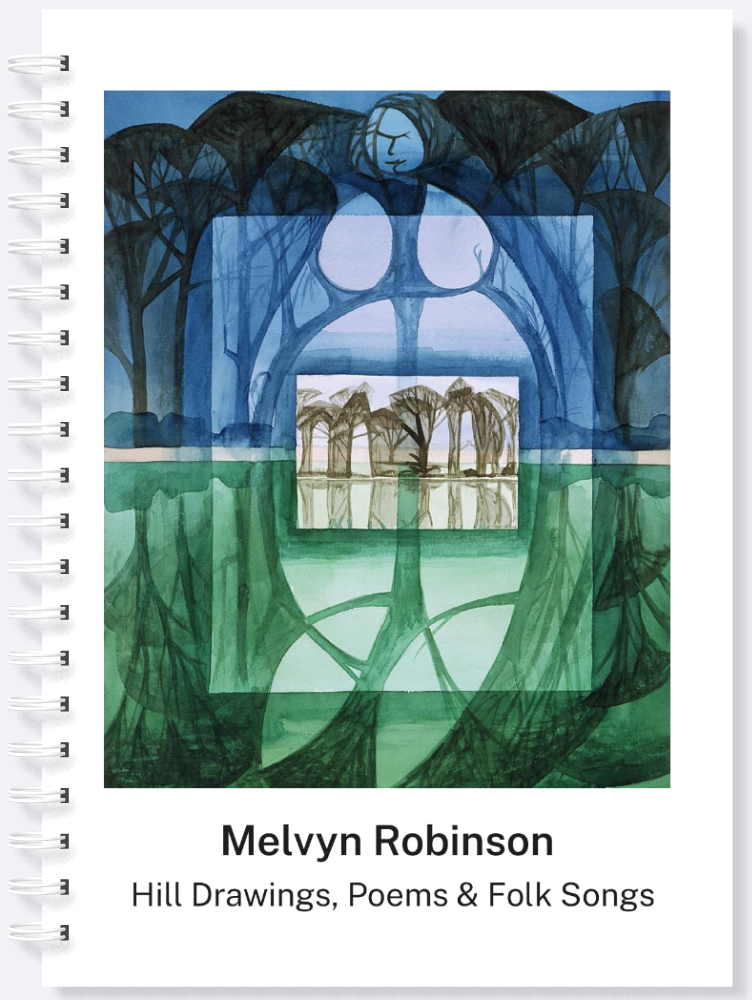
Explore the landscapes of South Yorkshire through a captivating collection of paintings, poetry and music by Melvyn Robinson.
Foreword
Melvyn Robinson
"The starting point for this series of paintings and poems was a number of sketches of a particular part of South Yorkshire, which I regard as my homeland. Kine Moor, Woolley Farm, Fox Holes, the Hill Forts and Boggard Wood are actual places. Although older folk traditions seem to have been lost in many industrialised parts of England, there is a legend in this locality of a black cockerel guarding a golden cradle in an underground passage which may predate the arrival of Christianity, and even the Roman military occupation of the North.
Superimposed on these watercolours is a drawing style derived from two hill drawings, Cerne Abbas in Dorset and the Uffington White Horse in Berkshire, as well as several other Celtic, Viking and Anglo-Saxon sources. The landscapes themselves are contemporary. The poems attempt to range further afield and across the centuries.
Developed in a random and haphazard manner over a number of years, with a vague objective of defining personal roots, certain clear, if rather obvious, themes presented themselves: generation, aggression, survival, and the fact that human beings are part of the animal kingdom. At the same time, less transparent themes seemed to emerge, such as industrial progress, relations between the sexes, and even religion.
Bearing in mind that many of the ‘big questions’ about life on Earth are not proper questions, reliable answers may not always be possible, and language can often be ambiguous or inaccurate, it should be said that no systematic treatment of any particular issue has been attempted here.
Combined art forms occur naturally in theatre, film and song. Here, paintings and poems are juxtaposed in fairly traditional forms. There is also related music written in a more or less traditional style. Paradoxically, part of this idea is that each form can, in fact, stand alone; however, the hope is that, in crossing boundaries, a wider context can be created."
October 2001

Melvyn Robinson Art
Book Hill Drawings
Share